
Rich old fashioned molasses made from apples
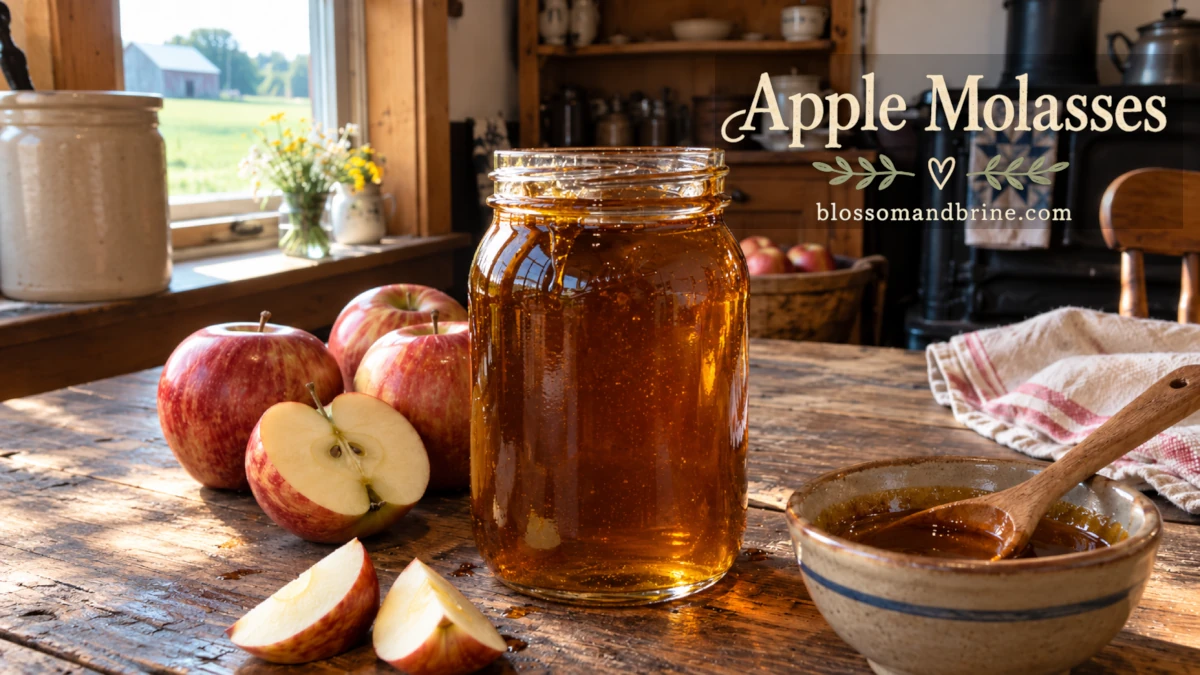
Apple molasses is made by slowly simmering pure apple cider until the natural sugars concentrate into a thick, glossy amber syrup. With no added sugar, it develops a deep apple flavor that can be used in baking, drizzled over biscuits or pancakes, or anywhere traditional molasses is used.
Ingredients
- 1 gallon fresh apple cider or pure apple juice
- Recipe How To Make Apple Cider
Yield: 1-1/2 cups to 2-1/2 cups depending on desired thickness and patience.
Instructions
- Pour the cider into a wide, heavy-bottomed, nonreactive pot.
- Bring it to a gentle simmer over medium-low heat. Do not hard-boil it. Leave the pot uncovered so the water can slowly evaporate.
- As it cooks, skim off any foam or impurities that rise to the surface.
- Continue simmering, stirring occasionally at first and more often as it thickens.
- Continue reducing until it reaches about 1/10 of its starting volume and becomes thick, glossy, and slow-flowing like molasses.
- One gallon of cider will generally give you about 1.5 to 2.5 cups finished product, depending on how far you reduce it.
- The finished molasses should be clear amber to deep golden-brown, thick enough to ribbon from a spoon, but still pourable.
Canning
This is a rebel canning recipe. It does not follow USDA guidelines. Use at your own risk.
Amish Water Bath Canning Method
Process in a water-bath canner (WB) or steam-bath canner (SB) for 30 minutes at elevations of 0–1,000 feet. If you live at a higher elevation, adjust the processing time using my family’s easy elevation chart in the Blossom & Brine™ Canning Times Guide. Start the timer at a full rolling boil, this is a boil that can't be stirred down.
Pressure Canning Method
Process in a pressure canner (PC) for 10 minutes for quarts and 10 mints for pints or smaller at 0–1,000 feet. If you live at a higher elevation, adjust the processing time using my family’s easy elevation chart in the Blossom & Brine™ Canning Times Guide.
📌 Instructions: How to water bath can, steam bath can, pressure can, open kettle can, and headspace.
Disclaimer: Recipes and methods are shared for educational purposes and may include traditional, historical, or home-developed food-preservation practices. Unless stated otherwise, they have not been evaluated or approved by the USDA. By choosing to use this information, you accept full responsibility for your decision and agree to the terms of our Liability Waiver.
Nutrition
| Serving: one tablespoon Calories: 60 kcal Total Fat: 0 g Saturated Fat: 0 g Total Carbohydrates: 15 g | Total Sugars: 14 g Cholesterol: 0 mg Sodium: 5 mg Fiber: 0 g Protein: 120 g |